

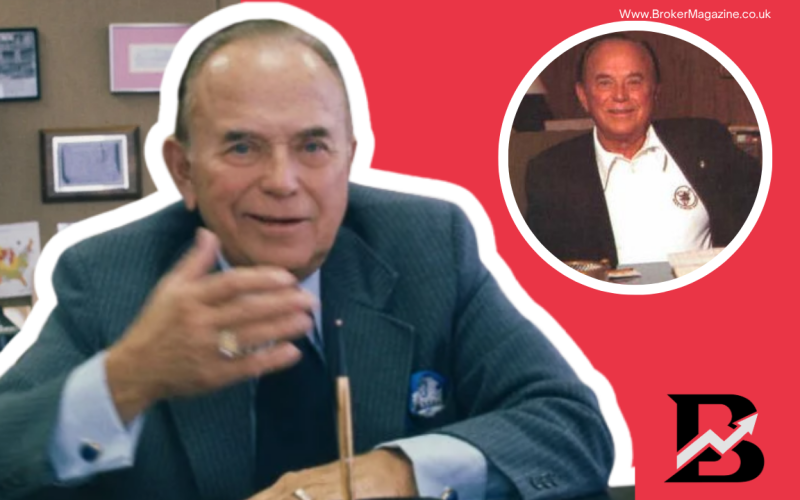
Ray Kroc Net Worth | How Much Was the McDonald’s Pioneer Worth?
Ray Kroc’s net worth was about $600 million at the time of his death in 1984, according to the widely cited estimate used for his final fortune. Because historical wealth estimates vary, some contemporary accounts placed his estate closer to $500 million or slightly above. Using the $600 million figure requested here, its purchasing-power equivalent in August 2026 is approximately $1.93 billion, based on U.S. Consumer Price Index data.
Kroc did not become wealthy simply by collecting a large executive salary. His fortune grew from a combination of McDonald’s ownership, franchising, real estate, royalties, and the enormous increase in the value of the business he built after acquiring control from Richard and Maurice McDonald.
The crucial transaction came in 1961, when Kroc acquired the McDonald brothers’ business for $2.7 million. He then expanded the system aggressively, standardized its operations and, with the help of financial executive Harry Sonneborn, developed a real-estate strategy through Franchise Realty Corporation. By the time Kroc died in January 1984, McDonald’s had roughly 7,500 restaurants across the United States and more than 30 other countries.
His wealth did not disappear after his death. His third wife, Joan Kroc, inherited the fortune and eventually became one of the most significant philanthropists associated with the McDonald’s legacy.
Ray Kroc Net Worth at Death
The commonly cited figure for Ray Kroc’s net worth at death is $600 million in 1984.
That number needs some historical context. Kroc’s January 1984 obituary in The New York Times described his family fortune as $500 million or more, while other later accounts have used approximately $600 million. In other words, $600 million is best treated as a historical estimate rather than a precisely audited figure.
| Measure | Amount |
|---|---|
| Reported Ray Kroc net worth at death | About $600 million |
| Year | 1984 |
| Inflation-adjusted equivalent using August 2026 CPI | About $1.93 billion |
| McDonald’s acquisition price in 1961 | $2.7 million |
| McDonald’s restaurants around Kroc’s death | About 7,500 |
The inflation-adjusted figure is useful for understanding purchasing power, but it should not be confused with what Kroc’s fortune would be worth if he had retained his assets and invested them in McDonald’s stock until today. Inflation adjustment measures changes in the general price level; it does not model investment returns.
How Ray Kroc Built His Fortune
Kroc’s wealth came from building a business system rather than relying on one source of income.
The basic model had several interconnected parts:
- Franchise expansion — independent operators financed and ran individual restaurants under the McDonald’s system.
- Franchise fees and royalties — McDonald’s received continuing revenue from restaurants operating under its brand and system.
- Real estate — Kroc and Harry Sonneborn developed a model in which McDonald’s controlled the property used by many franchisees.
- Corporate ownership — Kroc owned an important stake in the expanding corporation.
- Scale — as the number of restaurants increased, the value and earning power of the overall system increased dramatically.
This distinction matters. Kroc did not invent the original McDonald’s restaurant concept. Richard and Maurice McDonald had already developed their fast-service restaurant system in California. Kroc’s major contribution was turning that concept into a highly standardized, aggressively franchised national business and ultimately acquiring control of the company.
The 1954 discovery that changed Kroc’s career
Ray Kroc was working as a salesman for Prince Castle, a company associated with milkshake mixers, when he became interested in a restaurant in San Bernardino, California, operated by Richard and Maurice McDonald.
The brothers had ordered an unusually large number of mixers. Kroc visited the restaurant in 1954 and was impressed by how quickly the operation served customers with a limited menu and highly organized kitchen.
He saw something that went beyond the individual restaurant: a system that could potentially be reproduced in many locations.
Kroc became the brothers’ franchise agent and opened his first McDonald’s restaurant in Des Plaines, Illinois, in April 1955.
That restaurant was an important milestone, but it was not the beginning of McDonald’s itself. The brothers had been operating their restaurant business for years before Kroc arrived.
The 1961 McDonald’s Acquisition for $2.7 Million
Kroc eventually became frustrated by the limits placed on his ability to change and expand the McDonald brothers’ system.
The brothers wanted to protect their operating model, while Kroc wanted a much larger national chain. Their disagreements made it increasingly difficult for Kroc to implement the changes he believed were necessary for rapid expansion.
In 1961, Kroc bought the McDonald brothers’ business for $2.7 million.
McDonald’s own corporate history confirms the $2.7 million acquisition figure.
At the time, $2.7 million was a substantial amount of money. In hindsight, the transaction looks extraordinarily inexpensive compared with the value of the McDonald’s corporation that emerged over the following decades. But that outcome was not obvious in 1961. Kroc was taking substantial financial risks to obtain control of a business that was still in the process of proving that its model could work on a national scale.
The purchase gave Kroc much greater control over the McDonald’s name and operating system.
It also removed the central obstacle between Kroc and his vision for expansion.
Why the $2.7 million purchase mattered so much
The purchase itself did not instantly create Kroc’s fortune.
Its importance was that it gave him control of an unusually scalable business model.
Once Kroc controlled the company, he could pursue expansion without having to negotiate every major change with the original owners. The company could continue developing its franchise network, operating standards, advertising and real-estate strategy under one corporate direction.
The eventual value of the investment came from decades of compounding growth, not simply from the $2.7 million purchase.
The Real Estate Strategy Behind Ray Kroc’s Wealth
One of the least understood parts of the Ray Kroc story is the role of real estate.
Early McDonald’s economics were not especially attractive to Kroc. Franchise fees and royalties alone did not provide enough financial power to support the pace of expansion he envisioned.
Harry Sonneborn, a financial executive who became an important adviser to Kroc, proposed a different approach: McDonald’s should control the real estate on which restaurants operated.
Kroc established Franchise Realty Corporation in 1956 to pursue this strategy.
Instead of simply allowing a franchisee to find a location independently, the McDonald’s system could acquire or control property and then lease it to the restaurant operator.
That created another layer of economics.
How the model worked
A simplified version looked like this:
McDonald’s / Franchise Realty Corporation → controls property → leases property to franchisee → franchisee operates restaurant → McDonald’s receives rent and franchise-related revenue
This model provided several advantages at once.
First, it created another revenue stream.
McDonald’s could earn rental income in addition to franchise-related fees and royalties.
Second, it improved corporate control.
The company had greater influence over the location and operating conditions of individual restaurants.
Third, it helped finance expansion.
Real estate created an asset base that could support the growing business.
Fourth, it connected restaurant growth with property ownership.
As the number of McDonald’s locations increased, so did the importance of the underlying real estate portfolio.
This is why reducing Kroc’s wealth story to “he made money selling hamburgers” misses a major part of the business model.
The restaurant generated sales, but the broader corporate system combined franchising, brand licensing, rent and property ownership.
Scaling the Franchise System
Kroc’s next major advantage was scale.
The McDonald brothers had already demonstrated that their restaurant system could work. Kroc concentrated on making it repeatable across hundreds and eventually thousands of locations.
The company emphasized standardized food preparation, consistent menus, cleanliness, carefully selected franchisees and uniform operating procedures.
Kroc also favored a model in which individual franchisees operated specific restaurants rather than simply receiving enormous territories and operating independently.
That gave McDonald’s greater ability to maintain consistency while expanding.
By 1959, McDonald’s had opened its 100th restaurant. By 1960, the system had more than 200 locations. McDonald’s subsequently went public in 1965, providing another major stage in the company’s development.
By the early 1980s, the scale was dramatically different from the small chain Kroc had encountered in 1954.
At the end of 1983, McDonald’s systemwide sales exceeded $8 billion, and the chain had approximately 7,500 restaurants across the United States and 31 other countries and territories.
That growth explains how a businessman who bought the McDonald brothers’ company for $2.7 million could ultimately leave a fortune estimated in the hundreds of millions.
Did Ray Kroc Make His Money From a Salary?
Not primarily.
Kroc’s wealth should not be understood as the result of a conventional executive salary.
In fact, the early McDonald’s business was financially tight enough that Kroc did not draw a McDonald’s salary during its earliest years. Historical accounts based on John F. Love’s McDonald’s: Behind the Arches indicate that he was still relying on other income sources while the McDonald’s operation struggled to generate sufficient cash.
That is an important distinction.
A salary is an annual payment for someone’s work. Net worth is the accumulated value of assets minus liabilities.
Kroc became wealthy because he held valuable business interests as McDonald’s expanded. The long-term increase in the value of those interests was far more important to his fortune than any conventional paycheck.
Ray Kroc’s McDonald’s Shares
Kroc was a major owner and controlling figure in McDonald’s during the company’s development, but the exact composition of his personal holdings at the moment of his death is not as straightforward as many modern net-worth articles suggest.
McDonald’s became a publicly traded company in 1965. As the company expanded, its ownership structure changed, and Kroc’s personal wealth included more than simply a pile of McDonald’s shares.
His fortune was connected to the broader value created by the corporation, including its business interests and other assets.
After his death, Joan Kroc inherited a very large McDonald’s shareholding. Contemporary reporting in 1984 described her as McDonald’s largest shareholder after she inherited Ray’s fortune, and one contemporary account reported that she still held more than six million shares after selling 300,000 shares that year.
This is why it is misleading to calculate Ray Kroc’s fortune solely by multiplying a supposed final share count by a modern McDonald’s stock price.
What Happened to Ray Kroc’s Estate?
Ray Kroc died on January 14, 1984, in San Diego at age 81.
His third wife, Joan Kroc, inherited his fortune.
Joan was not simply a passive heir. During the years after Ray’s death, she became an influential philanthropist in her own right.
She also inherited his interest in the San Diego Padres, the Major League Baseball team Kroc had purchased in 1974.
Joan Kroc continued to hold a significant McDonald’s stake for a period, but she progressively gave away large amounts of her wealth.
Her fortune changed substantially during the nearly two decades between Ray’s death and her own death in 2003.
Joan Kroc’s Philanthropic Legacy
Joan Kroc’s philanthropy eventually became one of the most remarkable chapters of the Kroc family’s story.
She supported a wide range of causes, including:
- Health and medical research
- Hospice care
- AIDS and cancer research
- Education
- The arts
- Hunger and famine relief
- Youth and community programs
- Peace and nuclear-disarmament initiatives
- The Salvation Army
- National Public Radio
One of her largest philanthropic commitments came after her death.
In 2004, her estate announced a $1.5 billion gift to the Salvation Army to help establish community centers in underserved communities. The gift was structured so that roughly half would support construction and half would create an endowment for operating costs.
She had already funded a major community center in San Diego, which became the model for the later nationwide program.
Her estate also provided $200 million to National Public Radio, alongside substantial gifts to other educational, medical and cultural organizations.
The size of these gifts means that the story of Ray Kroc’s fortune did not end with inheritance. A substantial portion of the wealth generated through the McDonald’s empire was ultimately redirected toward philanthropy through Joan Kroc’s giving.
Ray Kroc Net Worth vs. McDonald’s Value
It is important not to confuse Ray Kroc’s personal net worth with the value of McDonald’s as a corporation.
These are two different numbers.
| Item | Meaning |
|---|---|
| Ray Kroc’s net worth | Estimated value of Kroc’s personal assets minus liabilities |
| McDonald’s corporate value | Value attributed to the publicly traded company |
| McDonald’s systemwide sales | Sales generated across company-owned and franchised restaurants |
| Franchise revenue | Money received by McDonald’s from franchise arrangements |
| Real-estate income | Revenue associated with property controlled or leased by the company |
By the time Kroc died, McDonald’s was vastly more valuable as a business than Kroc’s personal fortune.
That difference illustrates an important principle of entrepreneurship: creating a highly valuable company does not mean the founder personally owns 100% of that value.
Ray Kroc Net Worth in Today’s Money
Using the requested $600 million figure, the inflation adjustment is approximately:
$600 million in 1984 ≈ $1.93 billion in August 2026 purchasing power.
This calculation uses the U.S. Consumer Price Index rather than McDonald’s stock performance.
That distinction matters because there are at least three different ways someone could answer the question “What would Ray Kroc’s $600 million be worth today?”
1. Inflation adjustment
This asks:
How much money would be required in 2026 to purchase roughly what $600 million could purchase in 1984?
Answer: about $1.93 billion, using August 2026 CPI data.
2. Investment-growth calculation
This asks:
What if Kroc had invested the $600 million in stocks, bonds or another asset and held it?
That would produce a completely different number depending on the investment and assumed returns.
3. McDonald’s stock comparison
This asks:
What would Kroc’s historical McDonald’s ownership be worth if it had remained invested until today?
Again, that is a different calculation because it depends on the precise shares, sales, dividends, stock splits and subsequent investment decisions.
For a historical biography, the CPI-based figure is the cleanest way to communicate purchasing-power equivalence.
Ray Kroc’s Wealth-Building Timeline
| Year | Milestone |
|---|---|
| 1902 | Ray Kroc was born in Oak Park, Illinois |
| 1954 | Kroc visited the McDonald brothers’ San Bernardino restaurant |
| 1955 | He opened his first McDonald’s in Des Plaines, Illinois |
| 1956 | Franchise Realty Corporation was established |
| 1959 | McDonald’s reached its 100th restaurant |
| 1961 | Kroc acquired the McDonald brothers’ business for $2.7 million |
| 1965 | McDonald’s became a publicly traded company |
| 1967 | McDonald’s began international expansion with restaurants in Canada and Puerto Rico |
| 1969 | Kroc married Joan Mansfield |
| 1974 | Kroc purchased the San Diego Padres |
| 1983 | McDonald’s systemwide sales exceeded $8 billion |
| 1984 | Kroc died with a reported fortune of roughly $500 million to $600 million |
| 2003 | Joan Kroc died after years of major philanthropic giving |
| 2004 | Her estate announced a $1.5 billion gift to the Salvation Army |
What Ray Kroc Actually Contributed to McDonald’s
The simplest version of the story says that Ray Kroc “founded McDonald’s.”
Historically, that needs qualification.
Richard and Maurice McDonald created the original restaurant and developed the fast-service system that made their operation distinctive. Kroc encountered their concept later and became the person who transformed it into the large-scale McDonald’s corporation.
His contribution was largely about scaling, standardization, franchising, corporate control and financial structure.
That distinction does not make Kroc’s achievement less significant. It makes the history more accurate.
He took an existing restaurant concept and built an organization capable of reproducing it on a scale the original owners had not pursued.
That is also the key to understanding his fortune.
The Business Lesson Behind Ray Kroc’s Wealth
The most useful lesson from Kroc’s financial history is not simply that he bought McDonald’s cheaply.
It is that he recognized the difference between a successful location and a scalable system.
The McDonald brothers had proven that their restaurant could work.
Kroc focused on whether the same system could work hundreds or thousands of times.
Then the real-estate strategy added another layer. McDonald’s was no longer simply collecting franchise-related payments. It could also participate in the economics of the locations where its restaurants operated.
The result was a business with multiple reinforcing mechanisms:
standardized operations → franchise expansion → recurring fees and royalties → real-estate income → greater scale → greater corporate value
That structure explains far more about Ray Kroc’s wealth than the image of a businessman simply selling hamburgers.
Frequently Asked Questions About Ray Kroc’s Net Worth
How much was Ray Kroc worth when he died?
Ray Kroc was widely estimated to be worth about $600 million when he died in 1984. Contemporary reporting placed his family fortune at $500 million or more, so the exact figure should be treated as an estimate rather than a precise audited number.
How much would Ray Kroc’s $600 million be worth today?
Using U.S. inflation data through August 2026, $600 million in 1984 is approximately equivalent to $1.93 billion in 2026 purchasing power.
That is an inflation comparison, not a projection of what Kroc’s McDonald’s holdings would be worth today.
How did Ray Kroc make his money?
Kroc accumulated his wealth through his ownership and control of McDonald’s, franchise-related revenue, real estate and the growth in value of the McDonald’s business. The Franchise Realty Corporation was particularly important because it connected restaurant franchising with property ownership and leasing.
How much did Ray Kroc pay the McDonald brothers?
Ray Kroc paid $2.7 million to acquire the McDonald brothers’ business in 1961.
McDonald’s corporate history confirms the acquisition price.
Did Ray Kroc invent McDonald’s?
Not exactly.
Richard and Maurice McDonald created the original McDonald’s restaurant and developed the fast-service operating system. Kroc became their franchise agent, opened his own restaurant in 1955 and eventually acquired the business in 1961. He then expanded it into the large corporate and franchise system associated with McDonald’s today.
How much was Ray Kroc’s salary?
There is no single reliable figure that can be used as his final annual salary to explain his wealth.
In the early years, historical accounts indicate that Kroc did not draw a salary from McDonald’s until 1961. His wealth ultimately came much more from ownership and the appreciation of his business interests than from executive compensation.
How many shares of McDonald’s did Ray Kroc own?
The exact final number of shares attributable to Kroc should not be presented without qualification because his ownership changed over time and his estate included assets beyond McDonald’s stock.
After his death, Joan Kroc became a major McDonald’s shareholder. Contemporary reporting documented her ownership of millions of shares during 1984 and 1985.
Who inherited Ray Kroc’s fortune?
His third wife, Joan Kroc, inherited his fortune. She subsequently became a major philanthropist and gave away a very large portion of her wealth during her lifetime and through her estate.
What happened to Ray Kroc’s money after Joan Kroc died?
Joan Kroc directed enormous amounts of her fortune toward charitable causes. Among the largest commitments was a $1.5 billion bequest to the Salvation Army, while another $200 million went to National Public Radio. Her estate also supported numerous educational, medical, cultural and community organizations.
Conclusion
Ray Kroc’s net worth was approximately $600 million at his death in 1984, although contemporary estimates varied and some placed his fortune closer to $500 million or slightly above. At August 2026 purchasing power, $600 million would be roughly $1.93 billion.
The more revealing part of Kroc’s story is how that fortune was created.
He did not invent the original McDonald’s restaurant. Richard and Maurice McDonald did that. Kroc recognized the commercial potential of their system, expanded it through franchising, acquired the business for $2.7 million in 1961 and developed a real-estate strategy that gave McDonald’s another source of revenue and greater control over its franchise network.
The combination of franchising, standardization, real estate, recurring revenue and scale transformed a regional restaurant concept into one of the world’s most recognizable business systems.
After Kroc’s death, Joan Kroc inherited the fortune and eventually redirected a substantial share of it toward philanthropy. Her later gifts, particularly to the Salvation Army and NPR, became a major part of the Kroc family’s financial legacy.
For anyone studying entrepreneurship, Kroc’s story is therefore about more than a famous restaurant chain. It is a case study in how ownership, systems and scalable infrastructure can turn an established business concept into a much larger enterprise.