

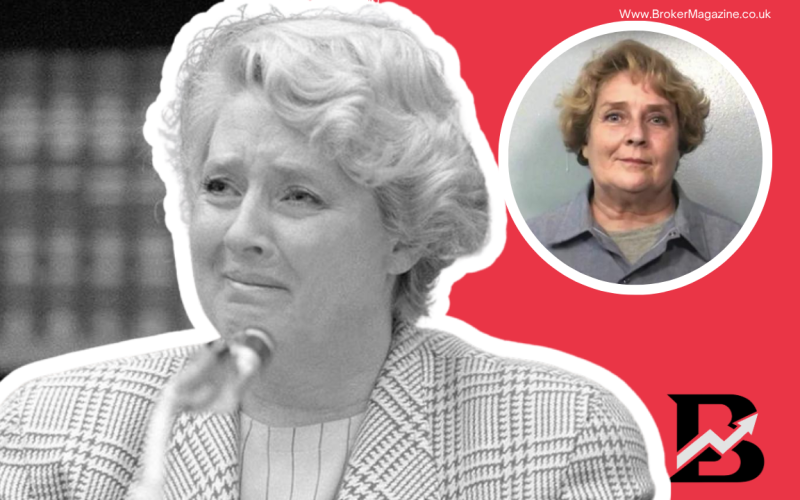
Betty Broderick Net Worth | The Financial Story Behind the Infamous Divorce
Betty Broderick’s net worth is difficult to state as a precise dollar figure because no authoritative public record establishes a final personal net-worth total. The most useful way to understand her finances is to separate the wealth accumulated by Daniel T. Broderick III during the marriage from the property and support Betty actually received after their divorce.
The historical record shows that Dan Broderick was earning more than $1 million a year by the mid-1980s, while Betty was receiving substantial monthly support during the divorce proceedings. Yet when the divorce was finally resolved in January 1989, the court’s financial calculations substantially reduced Betty’s share of the marital property. Contemporary accounts report a cash award of approximately $28,000, alongside roughly $16,000 per month in spousal support.
That distinction matters because online “net worth” estimates often confuse the Broderick family’s wealth with Betty Broderick’s personal assets. There is no reliable evidence that Betty retained a multi-million-dollar fortune after the divorce.
There is also an important current-status update. Betty Broderick is not currently incarcerated: she died on May 8, 2026, at age 78, after spending more than three decades in California’s prison system. The Los Angeles Times reported that she died in a hospital after being transferred from the California Institution for Women.
Who Was Betty Broderick?
Betty Broderick, formally Elisabeth Anne Broderick, became nationally known because of the collapse of her marriage to Daniel T. Broderick III and the 1989 killings of Dan and his second wife, Linda Kolkena.
Betty and Dan married in 1969 and built an affluent life in San Diego. Contemporary accounts describe Dan as a successful medical-malpractice attorney whose annual income had reached seven figures by the middle of the 1980s. Their marriage eventually ended in a highly contentious divorce that began after their 1985 separation.
The financial dispute became one of the central features of the divorce proceedings. Betty argued that she had contributed to the family’s economic success, including supporting Dan while he pursued medical and legal education. Later dramatizations of the case also place considerable emphasis on this part of their history.
But the question of how wealthy the Brodericks were is different from the question of how much wealth Betty ultimately retained.
Betty Broderick Net Worth: Is There a Reliable Figure?
There is no well-supported public figure for Betty Broderick’s personal net worth at the end of her life.
Several entertainment and “celebrity net worth” websites publish numbers ranging from zero to millions of dollars. Those figures should not be treated as established facts because they generally do not provide a documented balance sheet, probate record, tax filing, or other primary evidence capable of establishing Betty’s personal assets.
The historical record supports a more cautious conclusion:
| Period | Financial picture |
|---|---|
| During the marriage | The Brodericks lived an affluent lifestyle while Dan built a highly successful legal career. |
| 1985–1989 divorce | Betty received substantial monthly support while the parties fought over property, expenses, custody and marital debts. |
| January 1989 divorce judgment | Contemporary and retrospective accounts report approximately $28,000 in cash plus about $16,000 per month in spousal support. |
| November 1989 | Betty was arrested following the killings of Dan and Linda. |
| 1991–2026 | She remained incarcerated after her murder conviction and did not have a conventional career or publicly documented accumulation of wealth. |
| May 2026 | Betty died while in state custody. |
The safest answer to “What was Betty Broderick’s net worth?” is therefore not a made-up dollar amount, but an explanation: her former marital household was wealthy, while her documented post-divorce personal settlement was much smaller than the overall Broderick fortune.
How Much Money Did Betty Receive in the Divorce?
The final divorce financial picture is often misunderstood because several different numbers appeared during the years of litigation.
In late 1986, Betty sought substantially more support than Dan believed she required. The Los Angeles Times reported that she wanted $30,000 a month, while Dan’s own calculation put her needs at $7,316 per month. A judge eventually ordered Dan to pay $12,500 a month at one stage of the proceedings after finding that neither side’s position was reasonable.
By 1988, the support figure had risen to approximately $16,100 per month, according to reporting from the San Diego Reader. The Los Angeles Times subsequently described the January 1989 divorce judgment as requiring Dan to pay Betty about $16,000 a month, or $193,200 annually.
The monthly support should not be confused with a multi-million-dollar lump-sum settlement.
Retrospective accounts place the final cash award at approximately $28,000. Oprah Daily, for example, reports that Betty received $16,000 per month and a $28,000 cash award when the divorce was finalized.
The distinction can be summarized simply:
Monthly spousal support ≠ marital-property settlement ≠ total net worth.
Those were separate financial components of a much larger divorce dispute.
Why Was the Final Cash Settlement So Small?
One of the most important pieces of context is the treatment of expenses and what are commonly described in accounts of the case as Epstein credits.
The divorce proceedings lasted for years after the couple separated. During that period, Dan paid mortgages and other expenses associated with marital property and provided Betty with cash advances and support.
A 1989 Los Angeles Times investigation based on court documents described the financial dispute in considerable detail. It reported that Dan had been paying Betty $9,036 a month under an informal arrangement beginning in 1985 and that she also received other substantial payments, including proceeds connected to property sales.
The same reporting documented the very high income involved. Dan’s gross income was reported at approximately $1.2 million for the relevant year, illustrating why the dispute was not simply a disagreement between two people with modest household finances.
By the time the divorce judgment was reached, calculations concerning advances, debts and credits had significantly affected Betty’s share of the marital property. Retrospective accounts describe the resulting cash award as approximately $28,000.
This is also why saying “Betty received only $28,000 from Dan” is incomplete. She also had a substantial monthly support award, and the couple’s property and financial arrangements were considerably more complicated than a single cash payment suggests.
Dan Broderick’s Wealth Was Not the Same as Betty Broderick’s Wealth
This is the central distinction behind most confusion surrounding Betty Broderick’s net worth.
Daniel T. Broderick III had accumulated considerable wealth through his professional career. The Los Angeles Times reported that he was making more than $1 million a year during the divorce period. His income, professional assets and marital property formed part of the financial universe contested in the divorce.
That does not mean Betty personally owned millions of dollars.
Betty was largely financially dependent on the household income generated during the marriage. She received support payments and had access to property and other benefits during the separation, but the final divorce accounting produced a much smaller property settlement than the size of Dan’s income might lead a modern reader to assume.
The distinction is particularly important when reading modern net-worth websites. A website may take Dan’s earnings, the couple’s lifestyle, the value of their homes or later estimates of the Broderick estate and then implicitly attribute that wealth to Betty. That is not a sound method for determining her personal net worth.
A Timeline of the Broderick Family’s Financial History
1969: Marriage
Betty and Dan Broderick married and began raising a family. Dan later pursued both medical and legal education, while Betty supported the household and family during this period.
Early to mid-1980s: Wealth accumulation
Dan established himself as a prominent San Diego attorney. By the middle of the decade, his reported annual income had reached well into seven figures.
Contemporary records cited by the San Diego Reader indicated personal income of approximately $760,522 in 1984, $611,443 in 1985 and $1.37 million in 1986. Those figures illustrate the economic scale of the household, although they should not be confused with net worth.
February 1985: Separation
The couple separated on February 28, 1985. Dan filed for divorce in September of that year.
1985–1986: Temporary financial arrangements
Dan initially agreed to provide Betty with approximately $9,036 per month. Other payments and property-related transactions occurred during the same period.
1986–1988: The financial dispute intensifies
The divorce litigation continued. Betty sought substantially greater support, while Dan disputed the amount she required. By 1988, the monthly support figure was around $16,000.
January 1989: Divorce judgment
The divorce was finalized, and Betty’s final financial award was substantially smaller than the amounts she had sought. Accounts of the judgment put the cash component at approximately $28,000, with monthly support of about $16,000.
April 1989: Dan and Linda marry
Dan married Linda Kolkena several months after the divorce was finalized.
November 5, 1989: The killings
Betty entered Dan and Linda’s home and shot them. The deaths transformed a nationally followed divorce dispute into a major criminal case.
1991: Conviction
After an earlier trial ended without a verdict, Betty was convicted in a second trial of two counts of second-degree murder. She received a sentence of 32 years to life.
1990s–2026: Incarceration
Betty spent decades in California’s prison system, including time at the California Institution for Women. She became the subject of parole hearings and extensive true-crime coverage.
May 8, 2026: Death
Betty Broderick died at age 78 after being transferred from the California Institution for Women to a medical facility. The Los Angeles Times reported that California corrections authorities confirmed her death from natural causes.
Did Betty Broderick Lose a Multi-Million-Dollar Fortune After Her Conviction?
The evidence does not support the common version of that story.
There is a major difference between saying Betty did not retain the wealth associated with the Broderick household and saying the government seized a multi-million-dollar fortune from her after conviction.
The available reliable reporting does not establish a criminal asset-forfeiture judgment that transformed a large personal fortune into zero. Instead, the financial reduction largely occurred through the divorce itself, including the court’s accounting of property, debts, advances and support.
By the time Betty was convicted, she had also lost the opportunity to live a conventional life outside prison or build wealth through employment and investment.
Some low-quality websites describe her post-conviction financial situation as an “asset forfeiture” or claim that she lost Dan’s estate because of her conviction. Those descriptions go beyond what the reliable historical record establishes.
It is more accurate to say that Betty did not inherit or retain Dan’s wealth as her personal fortune, and there is no authoritative public accounting showing that she possessed a large personal estate later in life.
What Happened to Dan Broderick’s Estate?
Dan’s wealth should also not automatically be described as Betty’s inheritance.
At the time of the killings, Dan had remarried Linda Kolkena. Contemporary trial reporting also documented life-insurance arrangements involving Dan, Linda and his four children. The Los Angeles Times reported that Dan had a $2 million insurance policy, with $1 million designated for Linda and $250,000 for each of the four children.
These arrangements further demonstrate why the question “How much was Betty Broderick worth?” cannot be answered simply by looking at Dan’s earnings or estate.
A person’s household wealth, marital property rights, life-insurance proceeds and post-death inheritance rights are different financial concepts.
Did Betty Broderick Have a Job or Career?
Betty is principally documented as a homemaker and mother during her marriage rather than as someone who built a large independent professional fortune.
Accounts of the marriage emphasize her role in supporting the family while Dan completed his education and developed his legal career.
This financial dependence helps explain why the divorce settlement became such a major issue in the case. It does not, by itself, establish how much money Betty possessed at any particular later date.
There is insufficient reliable public documentation to calculate her lifetime personal assets, investments, debts and expenses precisely.
Was Betty Broderick Still in Prison?
Not anymore.
For decades, Betty was incarcerated at the California Institution for Women while serving her sentence for the 1989 killings. Earlier reporting described her as serving 32 years to life and being denied parole on multiple occasions.
That information is now historical rather than current.
On May 8, 2026, the Los Angeles Times reported that Betty died at age 78 in a hospital after being transferred from the California Institution for Women.
Consequently, articles that still describe Betty as a current inmate are outdated.
How Dirty John Changed Public Interest in the Case
The Broderick case received renewed attention decades after the original trials through true-crime documentaries, books, podcasts and scripted television.
The best-known modern dramatization is Dirty John: The Betty Broderick Story, the second season of the Dirty John anthology. It premiered in 2020 and starred Amanda Peet as Betty Broderick, Christian Slater as Dan Broderick and Rachel Keller as Linda Kolkena.
The series presents the financial and marital conflict as an important part of the story, including Betty’s claim that she had sacrificed while Dan pursued his professional education and career.
Like any dramatization, though, Dirty John should not be treated as a substitute for court records and contemporary journalism. It is a scripted interpretation of documented events rather than a financial statement or legal record.
The Most Important Financial Misconceptions
Several recurring claims about Betty Broderick’s money need qualification.
“Betty was a multi-millionaire.”
There is no reliable public evidence establishing that Betty personally possessed a multi-million-dollar fortune after the divorce.
Dan’s earnings and the couple’s affluent lifestyle were substantial, but those facts do not establish Betty’s individual net worth.
“Betty only received $28,000 from the divorce.”
That is also incomplete.
The approximately $28,000 figure refers to the reported cash component of the final settlement. Betty also received a substantial monthly spousal-support award, reported at approximately $16,000 per month.
“Her entire fortune was seized after the murders.”
The reliable historical sources reviewed for this article do not establish such a blanket criminal forfeiture.
Her financial circumstances were already heavily shaped by the divorce judgment. Later incarceration also meant that she did not have the normal opportunity to work and accumulate wealth.
“Her net worth was exactly $0.”
That claim is more precise than the available evidence allows.
A zero-dollar estimate may be used by some entertainment websites as shorthand for the absence of known income or significant assets. But without a verified personal balance sheet or estate accounting, an exact $0 net worth cannot responsibly be presented as a documented fact.
Betty Broderick Net Worth: What Can Actually Be Established?
The strongest evidence points to a much narrower conclusion than the numbers commonly circulated online.
What is documented:
- Dan Broderick earned more than $1 million annually during parts of the divorce period.
- Betty received thousands of dollars a month in support during the divorce.
- The support figure eventually reached roughly $16,000 per month.
- The final cash settlement is widely reported as approximately $28,000.
- The divorce accounting was affected by expenses, advances and credits accumulated during the lengthy separation.
- Betty was convicted of two counts of second-degree murder and spent decades incarcerated.
- She died in 2026 and therefore has no current “net worth” in the ordinary sense of an active public figure generating income.
What cannot be established confidently:
- A precise lifetime personal net worth for Betty.
- A verified multi-million-dollar personal fortune after the divorce.
- A reliable claim that the government confiscated a multi-million-dollar Betty Broderick estate after her conviction.
- A precise amount of money Betty possessed immediately before her arrest or at the time of her death.
That distinction is more useful than repeating an unsupported net-worth number.
Frequently Asked Questions
What was Betty Broderick’s net worth?
There is no authoritative public record establishing a precise personal net worth for Betty Broderick. Reliable historical reporting shows that she came from an affluent marriage but received a much smaller property settlement than the family’s overall wealth might suggest.
How much money did Betty Broderick get in the divorce?
Retrospective accounts report that Betty received approximately $28,000 in cash as part of the final settlement, along with roughly $16,000 per month in spousal support.
Did Betty Broderick receive $16,000 a month?
Yes. The January 1989 divorce judgment is reported by the Los Angeles Times as requiring Dan Broderick to pay approximately $16,000 per month, or about $193,200 annually.
Was Daniel Broderick a millionaire?
Contemporary Los Angeles Times reporting stated that Dan Broderick was earning more than $1 million annually during the divorce period. That figure describes income, not necessarily net worth.
Did Betty Broderick inherit Dan Broderick’s wealth?
The available record does not support treating Dan’s estate as Betty’s personal inheritance. Dan had remarried Linda Kolkena, and contemporary reporting documented insurance arrangements involving Linda and the four Broderick children.
Was Betty Broderick still in prison when she died?
Yes. She died on May 8, 2026, after being transferred from the California Institution for Women to a hospital. She was 78.
Where is the California Institution for Women?
The California Institution for Women is a California state prison facility in Chino. Betty Broderick was held there during the later decades of her sentence before being transferred for medical care shortly before her death.
Was Dirty John: The Betty Broderick Story based on a real case?
Yes. The second season of Dirty John, released in 2020, dramatized the real-life Broderick case, with Amanda Peet portraying Betty, Christian Slater portraying Dan and Rachel Keller portraying Linda Kolkena.
Why do websites give different figures for Betty Broderick’s net worth?
Most published net-worth numbers are estimates rather than figures supported by a public financial statement. Some sites also confuse Dan Broderick’s income and assets with Betty’s personal wealth. The surviving historical record supports specific divorce figures much more strongly than it supports a precise lifetime net-worth estimate.
Conclusion
The financial story behind Betty Broderick is more complicated than the phrase “Betty Broderick net worth” suggests.
Dan Broderick accumulated considerable wealth through his San Diego legal career, earning more than $1 million annually during parts of the divorce. Betty received substantial monthly support during the litigation, but the final property settlement was dramatically smaller than the overall wealth associated with the marriage. Contemporary and retrospective accounts place the cash settlement at approximately $28,000, with monthly support of about $16,000.
There is no reliable evidence establishing that Betty personally retained a massive multi-million-dollar fortune after the divorce, nor is there sufficient evidence to assign her an exact zero-dollar net worth. The most defensible approach is to distinguish documented financial awards from speculative modern net-worth estimates.
Her story also needs to be kept in its proper historical context. The divorce dispute preceded the 1989 killings, and the subsequent murder conviction and decades of incarceration fundamentally changed the course of her life. Betty Broderick died in 2026, ending a prison sentence that had lasted more than three decades.
For readers researching the case, contemporary court reporting and archival journalism provide a more reliable picture of the money than celebrity-net-worth websites or dramatized television accounts.