

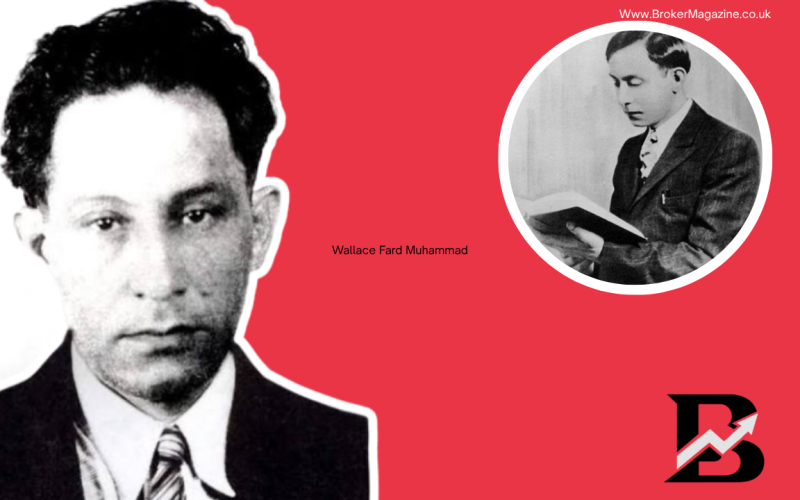
Wallace Fard Muhammad | The Founder of the Nation of Islam
Wallace Fard Muhammad was the mysterious religious teacher who established the movement that became the Nation of Islam (NOI) in Detroit in 1930. He appeared in the city among Black residents during the Great Depression, preached a distinctive interpretation of Islam and Black identity, and attracted thousands of followers before disappearing from public view in 1934. The National Archives identifies him as the founder of the Nation of Islam and records that Elijah Muhammad succeeded him in 1934.
Yet almost every part of Fard Muhammad’s personal biography is surrounded by uncertainty. His names varied, his claimed birthplace and ancestry remain disputed, and the exact circumstances of his disappearance are unknown. Later Nation of Islam theology gave him a sacred status that should be distinguished from what historians can establish from documentary evidence.
The most responsible way to understand Wallace Fard Muhammad is therefore to separate documented history, contemporary reports, later Nation of Islam tradition, and unresolved questions.
Who Was Wallace Fard Muhammad?
Wallace Fard Muhammad, also known as W. D. Fard, Wali Fard Muhammad, W. F. Muhammad, and other variations, was the founder and first major teacher of the Nation of Islam.
He appeared in Detroit in 1930 and initially operated as a traveling salesman, selling goods door to door in Black neighborhoods. His religious message developed through conversations and meetings with African Americans, many of whom had migrated north from the American South during the Great Migration.
Fard taught that Black Americans had an original religious and cultural identity that had been obscured by slavery and Christianity. His message combined Islamic terminology with Black nationalist ideas and teachings that differed significantly from mainstream Sunni and Shi’a Islam.
By the early 1930s, his organization had developed temples, ministers, schools, and a growing body of followers. One of his most important followers was Elijah Poole, who later became known as Elijah Muhammad.
Fard’s disappearance in 1934 created a leadership crisis. Elijah Muhammad eventually emerged as the movement’s central leader and transformed the organization into the Nation of Islam that became nationally prominent decades later.
When Did Wallace Fard Muhammad Found the Nation of Islam?
The Nation of Islam was founded in Detroit in 1930.
Nation of Islam tradition commonly identifies July 4, 1930, as the date Fard Muhammad arrived in Detroit and began his mission. Academic and reference sources likewise place the organization’s origins in Detroit in July 1930, although the precise meaning of July 4—as an arrival date, founding date, or traditional commemorative date—should not be confused with a fully documented modern organizational incorporation date.
The historical setting is important. Detroit was experiencing enormous demographic change during the Great Migration. African Americans arriving from the South encountered industrial employment, severe racial discrimination, segregated housing, and communities searching for new forms of political, cultural, and religious identity.
Fard’s message addressed that environment directly.
Wallace Fard Muhammad in Detroit, 1930–1934
A religious teacher who first worked as a salesman
Contemporary and later accounts describe Fard as a peddler who visited Black households in Detroit.
He reportedly sold items such as silks and clothing while engaging potential customers in conversations about their ancestry, religion, health, and identity. Rather than simply selling merchandise, he used these encounters to introduce his religious teachings.
Erdmann Doane Beynon, a sociologist who studied the movement during the 1930s, documented interviews with early Nation of Islam followers. His 1938 article in the American Journal of Sociology remains one of the earliest scholarly examinations of the movement.
According to later scholarship, Fard initially used the Bible in his teaching because it was familiar to the largely Christian audience he encountered. His message subsequently became increasingly focused on Islam, Black identity, racial history, and the idea that African Americans needed to recover an original religious and cultural identity.
From home meetings to Temple No. 1
Fard’s early meetings reportedly took place in private homes. As his following grew, the organization developed more formal meeting spaces, eventually establishing what became Temple No. 1 in Detroit.
Reference works describe the movement as emerging in Detroit’s Paradise Valley area, where Fard preached to Black residents and developed a distinctive religious message centered on knowledge of self, Islam, racial identity, and independence.
His teachings also drew on intellectual and religious currents that already existed in African American communities. Scholars have connected early Nation of Islam ideas with Black nationalism, Marcus Garvey’s movement, and the Moorish Science Temple of America founded by Noble Drew Ali. This does not mean the Nation of Islam was simply a continuation of either movement; rather, Fard’s teachings developed within an existing environment of Black religious experimentation and racial self-determination.
What Did Wallace Fard Muhammad Teach?
Fard’s teachings were distinctive and should be understood in their historical context.
He taught that African Americans were the descendants of an original Black or “Asiatic” people whose true religion was Islam. He emphasized racial pride, self-knowledge, economic independence, discipline, and separation from institutions he regarded as instruments of white domination.
Some of these ideas were later systematized and expanded by Elijah Muhammad.
This distinction matters because the teachings attributed to Fard in later Nation of Islam literature are not necessarily identical to the teachings historians can establish from the earliest surviving evidence. The movement changed considerably under Elijah Muhammad, and later Nation of Islam theology gave Fard an increasingly exalted position.
Herbert Berg, a scholar of the Nation of Islam, notes that Fard’s origins and early teachings remain subjects of scholarly debate and that his successor, Elijah Muhammad, substantially elaborated the movement’s religious formulation.
Wallace Fard Muhammad and Elijah Muhammad
One of the most consequential relationships in Fard’s biography was his relationship with Elijah Poole, later known as Elijah Muhammad.
Poole joined Fard’s movement in Detroit in the early 1930s and became one of his most prominent followers. Fard eventually gave him a leadership role, and Poole adopted the name Elijah Muhammad.
Elijah Muhammad later became the central figure of the Nation of Islam after Fard disappeared. He preserved Fard’s teachings while also developing them into a much more extensive religious, social, and organizational system.
The transition was not entirely straightforward. Early accounts indicate that Fard’s disappearance left the organization without a clearly designated successor, and competing claims over leadership followed. By 1934, Elijah Muhammad had emerged as the movement’s leading figure.
The National Archives summarizes the succession plainly: Fard founded the movement in Detroit in 1930, and Elijah Muhammad succeeded him in 1934.
Why Did Wallace Fard Muhammad Disappear?
Fard Muhammad disappeared from the public record in 1934, and there is no universally accepted account of what happened to him afterward.
This is one of the central mysteries surrounding his life.
FBI records contain reports indicating that Fard had encountered Detroit authorities and that he was ordered to leave the city. Other FBI material places him in Chicago during part of the early 1930s and records his whereabouts as unknown after 1934. The surviving FBI files are investigative records rather than a definitive biography, so their claims should be treated as evidence of what investigators reported, not automatically as proven fact.
Later accounts have proposed several explanations for his disappearance, including deportation, voluntary departure, travel abroad, or death. None has been conclusively established as the final answer.
What can be stated with confidence is narrower:
- Fard was active in Detroit beginning in 1930.
- He had become the central teacher of the emerging movement.
- He was no longer publicly leading the organization by 1934.
- Elijah Muhammad subsequently assumed leadership.
- Fard’s later whereabouts have never been conclusively established.
That uncertainty is part of the historical record rather than something that needs to be filled with speculation.
Was Wallace Fard Muhammad Actually Wallie D. Ford?
This is probably the most persistent historical question about Fard’s identity.
The FBI investigated whether Fard was the same person as Wallie D. Ford, a man who had lived in California and had a criminal record. FBI records contain extensive material concerning both Fard and Ford, including fingerprint-related documentation and investigative references to the Ford name.
The identification has been accepted by a number of historians and scholars, while the Nation of Islam has rejected it.
Academic reference works therefore usually present the Ford identification as an important historical theory rather than simply repeating the Nation of Islam’s traditional account. Herbert Berg’s Oxford Bibliographies entry, for example, describes the origins of Fard as disputed while noting the FBI’s identification of him as Wallace D. Ford and Elijah Muhammad’s rejection of that claim.
The situation is complicated by the fact that FBI files contain investigative leads, conflicting reports, and material gathered years after Fard disappeared. The existence of an FBI investigation does not by itself settle every question about his identity.
What does the historical evidence establish?
A careful summary looks like this:
| Question | What can responsibly be said |
|---|---|
| Was Fard a real historical person? | Yes. His activities in Detroit and the early Nation of Islam are documented. |
| Did he use multiple names? | Yes. Contemporary and later sources record several names and spellings. |
| Did he found the Nation of Islam in Detroit? | Yes. Major archival and scholarly sources identify him as its founder in 1930. |
| Was he Wallie/Wallace D. Ford? | Strongly argued in historical and investigative literature, but disputed by the Nation of Islam. |
| Was he born in Mecca? | This is part of Nation of Islam tradition, not an independently established historical fact. |
| What happened to him after 1934? | Uncertain. No definitive account has been established. |
What Were Wallace Fard Muhammad’s Other Names?
The variation in Fard’s name is one reason research about him can become confusing.
Sources use forms including:
- Wallace Fard Muhammad
- W. D. Fard
- W. F. Muhammad
- Wali Fard Muhammad
- Wali Farrad Muhammad
- Mr. Fard
- Farrad Muhammad
- Wallace D. Ford
- Wallie D. Ford
The spelling “Fard” itself appears in different forms across historical documents and secondary literature.
The variations do not necessarily mean that every person recorded under one of these names was the same individual. This is particularly important when examining FBI records, immigration documents, prison records, and other archival material, where similar names can produce investigative leads that were not necessarily verified identifications.
For this reason, researchers should avoid treating every historical alias attributed to Fard as equally certain.
What Was Wallace Fard Muhammad’s Claimed Origin?
Fard’s origins are perhaps the least certain part of his biography.
Nation of Islam tradition presents him as having an extraordinary sacred and geographic identity, including a connection to Mecca. Later Nation of Islam teachings also gave him a theological status far beyond that of an ordinary religious teacher.
Historians, meanwhile, have proposed numerous possibilities for his ethnic and geographic background.
John Andrew Morrow’s Finding W.D. Fard, a major modern study devoted specifically to the question, reviews competing theories concerning Fard’s ancestry and identity and emphasizes how many contradictory possibilities have appeared in the historical literature.
Some theories have identified him with people of African American, Arab, South Asian, Middle Eastern, European, or other backgrounds. The sheer number of competing proposals is itself a warning against presenting any one speculative origin as settled fact.
Nation of Islam tradition versus historical evidence
The distinction can be summarized simply:
Religious tradition: Fard was a divinely significant figure whose origins and identity were connected to the sacred history taught within the Nation of Islam.
Historical scholarship: Fard was a real religious teacher who appeared in Detroit in 1930, founded the movement that became the Nation of Islam, and disappeared in 1934; his precise ancestry and earlier life remain disputed.
These are different kinds of claims. A religious community may preserve theological beliefs that cannot be tested by the same methods historians use to establish documentary facts.
A respectful historical account should report both without treating theology as archival proof or dismissing believers’ traditions merely because they are theological.
Wallace Fard Muhammad’s Religious Status in Nation of Islam Theology
Fard’s role changed significantly after his disappearance.
In the religious system developed by Elijah Muhammad, Fard came to occupy a divine or near-divine position. Scholars describe Elijah Muhammad’s later teachings as identifying Fard with Allah in human form and presenting him as the source of the movement’s religious message.
This is an important distinction when discussing Fard historically.
The statement that “Fard Muhammad was Allah” is a theological claim of the Nation of Islam, not a proposition that historians can independently verify through conventional historical evidence.
Likewise, accounts of Fard as the Mahdi, Messiah, or divinely appointed figure belong to the religious tradition surrounding the movement. Reference works document these beliefs, but they should be labeled as beliefs rather than presented as objectively established biographical facts.
C. Eric Lincoln and the Academic Study of the Nation of Islam
The Nation of Islam attracted sustained academic attention particularly after its expansion in the mid-20th century.
Sociologist C. Eric Lincoln played an influential role with The Black Muslims in America, first published in 1961. His work helped establish the Nation of Islam as an important subject within the academic study of American religion, race, and social movements.
Lincoln’s interpretation was influential, but scholarship on African American Islam has continued to develop. Later researchers have questioned some earlier descriptions of the Nation of Islam and have placed greater emphasis on its religious history, internal development, Black intellectual traditions, and relationship to Islam.
That evolution is useful when researching Fard because much of the earliest academic literature was produced through limited documentary evidence and contemporary assumptions about the movement.
Clifton E. Marsh and the Development of the Nation of Islam
Historian Clifton E. Marsh examined the Nation of Islam’s development in From Black Muslims to Muslims: The Transition from Separatism to Islam, 1930–1980.
Marsh’s work places the movement within the wider history of Black nationalism, African American religion, the Moorish Science Temple, and changing interpretations of Islam in the United States.
This broader perspective is essential because Fard did not emerge in an intellectual vacuum. His teachings developed during a period when African Americans were exploring questions of race, religion, migration, economic independence, and cultural identity.
The Historical Importance of Wallace Fard Muhammad
Fard’s personal biography may be obscure, but his historical influence is substantial.
His four-year public ministry established the foundation for an organization that would later become one of the best-known Black religious movements in the United States. Under Elijah Muhammad, the Nation of Islam developed a national network and eventually produced influential figures including Malcolm X and attracted public attention through personalities such as Muhammad Ali.
The organization also influenced debates about Black identity, racial separatism, religion, self-determination, economic independence, diet, discipline, and African American political thought.
Fard himself did not remain to oversee most of that later development. His historical significance therefore comes partly from the contrast between the brevity of his documented public career and the enormous institutional and ideological legacy attributed to his teachings.
A Timeline of Wallace Fard Muhammad
| Year | Event |
|---|---|
| 1930 | Fard Muhammad appears in Detroit and begins teaching the ideas that develop into the Nation of Islam. |
| 1930–1933 | He builds a growing religious movement among Black Detroit residents and establishes organized meetings and Temple No. 1. |
| 1931 | Elijah Poole becomes associated with Fard and eventually becomes one of his principal followers. |
| 1933 | Fard faces continued attention from authorities; historical records place him in Chicago during part of this period. |
| 1934 | Fard disappears from public view. Elijah Muhammad emerges as the movement’s leading figure. |
| After 1934 | Fard’s whereabouts remain uncertain, while the Nation of Islam develops under Elijah Muhammad. |
| 1961 | C. Eric Lincoln publishes The Black Muslims in America, helping establish academic study of the movement. |
| 1984 | Clifton E. Marsh publishes From Black Muslims to Muslims, examining the movement’s development from 1930 to 1980. |
| 2019 | John Andrew Morrow publishes Finding W.D. Fard, focusing specifically on the mystery surrounding Fard’s identity and origins. |
The timeline reflects the broad historical record rather than every disputed claim about Fard’s movements or identity.
What We Know and What Remains Unknown
The most useful way to approach Wallace Fard Muhammad is to distinguish established history from unresolved questions.
Relatively well established
- Fard appeared in Detroit in 1930.
- He founded the movement that became the Nation of Islam.
- He preached to African Americans and developed a distinctive religious message.
- He became the teacher and religious authority of a growing community.
- Elijah Poole, later Elijah Muhammad, became one of his important followers.
- Fard disappeared from public life in 1934.
- Elijah Muhammad subsequently became the movement’s dominant leader.
Still disputed
- His exact birthplace.
- His parents and family background.
- His ethnicity and nationality.
- Whether every historical alias attributed to him belonged to the same person.
- The precise nature of his relationship to Wallie D. Ford.
- Whether he left the United States voluntarily or under official pressure.
- His whereabouts and fate after 1934.
- Which elements of later Nation of Islam theology originated directly with Fard and which were developed or expanded by Elijah Muhammad.
This distinction is especially important because Fard’s mystery has encouraged many dramatic claims. A good historical biography should resist the temptation to turn an unresolved question into a definitive story.
Frequently Asked Questions About Wallace Fard Muhammad
Who was Wallace Fard Muhammad?
Wallace Fard Muhammad was the founder of the Nation of Islam, a religious movement that emerged in Detroit in 1930. He taught a distinctive interpretation of Islam, Black identity, racial history, and self-determination before disappearing in 1934.
When did Wallace Fard Muhammad found the Nation of Islam?
The Nation of Islam was founded in Detroit in 1930. Nation of Islam tradition commonly gives July 4, 1930, as the founding or arrival date, while historians generally describe the movement’s emergence as occurring in Detroit during 1930.
Was Wallace Fard Muhammad also called W. D. Fard?
Yes. Historical sources use several forms of his name, including W. D. Fard, Wali Fard Muhammad, and Wallace Fard Muhammad. Other names and spellings also appear in archival and scholarly sources.
Was Wallace Fard Muhammad really Wallie D. Ford?
The FBI investigated and identified a possible connection between Fard and Wallie D. Ford, and the identification has been accepted by some historians. The Nation of Islam has rejected the identification. Because the surviving records include investigative material and disputed evidence, the question should be described as a major historical identification rather than an uncontested biographical fact.
Was Wallace Fard Muhammad born in Mecca?
The claim that Fard was from Mecca belongs to Nation of Islam tradition. His independently verifiable birthplace and early life remain uncertain, so Mecca should not be presented as an established historical fact without qualification.
What happened to Wallace Fard Muhammad?
He disappeared from public view in 1934. Records document earlier encounters with authorities and different reported locations, but no definitive account establishes where he went or what happened to him afterward.
Who succeeded Wallace Fard Muhammad?
Elijah Muhammad became the leading figure of the Nation of Islam after Fard’s disappearance. He subsequently expanded and reshaped the movement over several decades.
Did Wallace Fard Muhammad teach that he was Allah?
Later Nation of Islam theology identified Fard with Allah in human form. Historical scholarship treats that as a theological claim within the movement rather than as an independently verifiable historical fact. The exact development of this doctrine and how it relates to Fard’s earliest teachings remain subjects of scholarly discussion.
Why is Wallace Fard Muhammad historically important?
Fard established the foundation of the Nation of Islam, one of the most influential Black religious movements in modern American history. Although his documented public career lasted only a few years, the movement he began later influenced American discussions of race, religion, Black nationalism, identity, and social independence.
Conclusion
Wallace Fard Muhammad remains one of the most enigmatic figures in American religious history. What is comparatively clear is that he appeared in Detroit in 1930, established the movement that became the Nation of Islam, attracted a substantial following, and disappeared four years later. His teachings became the foundation on which Elijah Muhammad built a much larger and longer-lasting organization.
What remains unclear is equally important: Fard’s true origins, the full story behind his many names, the strength of the evidence connecting him to Wallie D. Ford, and his ultimate fate.
For students of American religious history, the mystery surrounding Wallace Fard Muhammad is best treated not as an invitation to speculation but as a reason to examine the evidence carefully. Primary records, early sociological research, archival material, and later scholarship can establish parts of his story, while theological traditions and unresolved claims should be identified as such. That distinction produces a more accurate account of both Fard Muhammad and the Nation of Islam he helped create.
Author Biography
| Author | Biography |
|---|---|
[Author Name] | [Biography not supplied. Replace this placeholder with the author's verified biography before publication.] |
Image Suggestions
Image Idea: A historically appropriate photograph or archival representation associated with Wallace Fard Muhammad, with clear attribution and copyright status.
Suggested Alt Text: Archival image associated with Wallace Fard Muhammad, founder of the Nation of Islam
Image Idea: A historical photograph of Detroit’s Paradise Valley or the surrounding Black community during the early 1930s to provide context for the environment in which the Nation of Islam emerged.
Suggested Alt Text: Detroit's Paradise Valley area during the early 1930s
Image Idea: A simple horizontal timeline showing the Nation of Islam’s emergence in Detroit in 1930, Fard Muhammad’s disappearance in 1934, and Elijah Muhammad’s subsequent leadership.
Suggested Alt Text: Timeline of Wallace Fard Muhammad and the early Nation of Islam from 1930 to 1934
Meta Title
Wallace Fard Muhammad: Founder of Nation of Islam
Meta Description
Learn who Wallace Fard Muhammad was, how he founded the Nation of Islam in 1930, and what history can and cannot establish about his mysterious origins.
Suggested URL Slug
wallace-fard-muhammad